



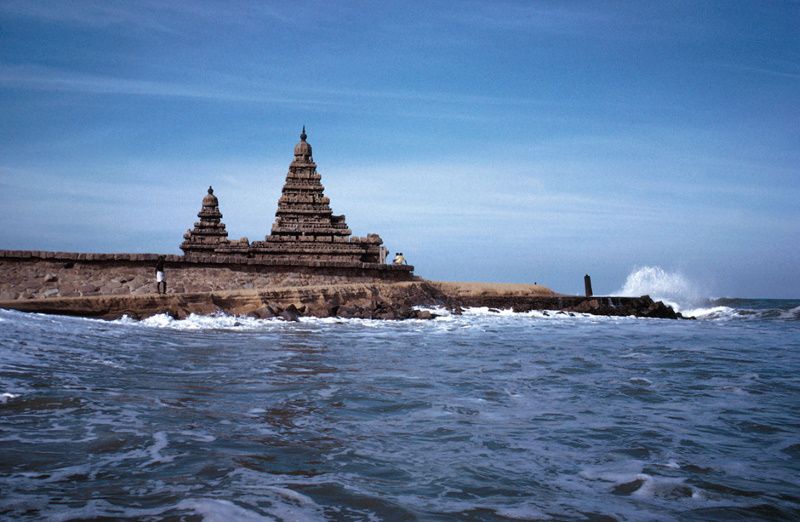
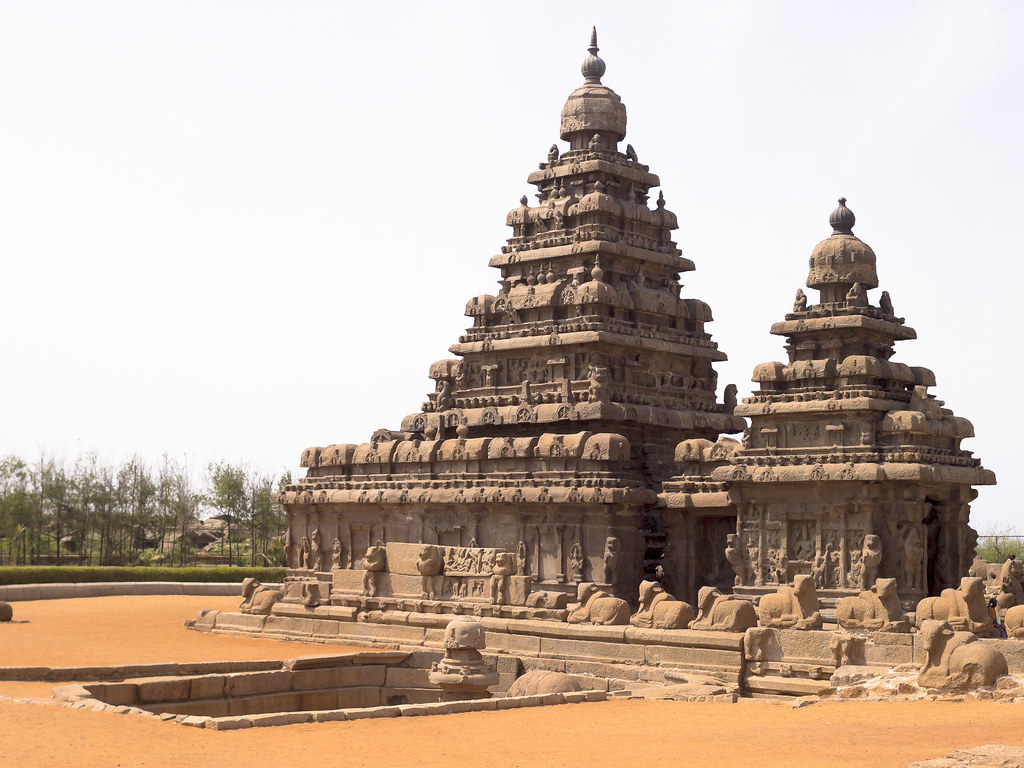
The Shore Temple, located along the scenic coastline of Mamallapuram (Mahabalipuram) in Tamil Nadu, is one of India’s earliest and finest examples of structural stone temples. Built between 700–728 CE during the reign of Pallava King Narasimhavarman II (Rajasimha), the temple stands majestically facing the Bay of Bengal, earning its name for its distinctive seafront location. Recognized as part of the UNESCO World Heritage-listed Group of Monuments at Mahabalipuram, the Shore Temple represents the architectural transition from rock-cut caves and monolithic rathas to structural temples carved from granite blocks. It is one of South India’s most iconic landmarks and a must visit heritage site.
History
A
Legendary “Seven Pagodas” Shrine
European
travellers such as Marco Polo referred to Mahabalipuram as the land of the “Seven
Pagodas”, inspired by the towering temple structures that once lined this
coast. The Shore Temple is believed to be the only surviving structure of these
ancient temples, while the others may have submerged due to sea erosion and
natural calamities.
Pallava
Excellence
During
the 7th–8th centuries CE, Mahabalipuram served as a thriving port city under
the Pallavas. The Shore Temple marks the pinnacle of their architectural
innovation—shifting from monolithic cave shrines to freestanding structural
temples built with precisely shaped granite blocks.
Rediscoveries
After the 2004 Tsunami
The
2004 Indian Ocean Tsunami briefly receded the sea, exposing:
These
discoveries strengthened the historical belief that several other Pallava
temples once stood along this coastline.
Architecture
The
Shore Temple is a structural complex of three shrines, all resting on a shared
granite platform:
1.
Two Shiva Shrines
2.
Vishnu Shrine (Middle)
Other
Architectural Highlights
Miniature
Shrine & Unique Finds
Archaeological
excavations uncovered:
These
elements display the Pallavas’ artistic depth and mythological integration.
Cultural
& Symbolic Significance
Today,
the Shore Temple stands as:
Timings
& Entry
How
to Reach
Map
The
Shore Temple is well‑connected to major transport routes:
By
Air
By
Rail
By
Road
Nearby
Attractions
Arjuna’s
Penance
A
massive monolithic bas‑relief illustrating scenes believed to depict Arjuna’s
penance or the descent of the Ganges.
Panch
Rathas
Five
monolithic rock-cut temples shaped like chariots, built under Pallava King
Narasimhavarman I.
India
Seashell Museum
India’s
largest seashell museum with over 40,000 shell varieties.
Mahishasuramardini
Mandapam
Rock‑cut
cave temple showcasing Durga slaying the buffalo demon.
Other
nearby attractions include:
Deities
Visitor
Tips
Contact
Phone no.:
+91-44-2533 3851/2533 3854/ 044-27442223
Email:
dipr@tn.gov.in
Address:
Beach Road, Mamallapuram, Tamil Nadu, 603104
Website:
https://www.tamilnadutourism.tn.gov.in/destinations/mamallapuram-shore-temple