



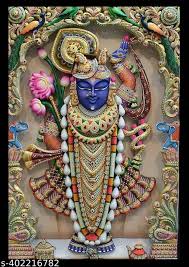
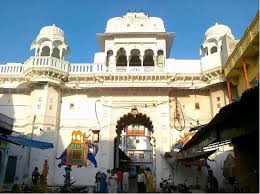
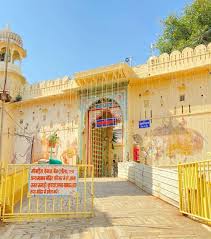
Shrinathji Temple, located in Nathdwara in Rajasthan’s Rajsamand district, is one of the most revered temples dedicated to Lord Krishna. The deity is worshipped here in the form of Shrinathji, a manifestation of Krishna lifting the Govardhan Hill. The temple, operated according to the traditions of Pushtimarg founded by Jagadguru Vallabhacharya, is considered the main seat of devotion for Vaishnavas across the world. The temple is not viewed as a typical shrine but as Shrinathji’s Haveli—the divine residence of the Lord—where daily life, rituals, and services (seva) are performed as if caring for a living child-form of Krishna.
History
of Shrinathji Temple
The
divine image of Shrinathji is believed to be a self-manifested form of Lord
Krishna emerging from the sacred Govardhan Hill near Mathura. During the
17th century, due to the threat of Mughal invasions under Emperor Aurangzeb,
the idol was moved for protection.
In 1672
CE, while being transported south, the bullock cart carrying the deity stopped
on its own at village Sihad (Sinhad) and would not move further. The
accompanying priests interpreted this as a divine sign indicating that the Lord
wished to reside there.
Under
the patronage of Maharana Raj Singh of Mewar, a temple was established at the
site. The shrine was built by Goswami Damodar Das Bairagi, making it one of the
most important centers of Krishna worship.
The
temple later came under the custodianship of the Tilkayat Maharaj, as
documented in a formal order issued by the Udaipur royal court in 1934.
Architecture
of the Temple
Shrinathji
Temple was designed in the style of Nanda Maharaj’s house in Vrindavan,
reflecting the childhood home of Krishna. Known locally as Shrinathji ki Haveli,
the complex includes various rooms symbolizing the domestic atmosphere of
Krishna’s early years.
Key
Architectural and Functional Spaces:
The
shikhara of the temple carries:
Pure
white marble walls and intricate motifs enhance the traditional charm of this
historic 17th‑century structure.
Daily
Darshan Timings
The
temple follows a unique daily schedule where Shrinathji is treated like a
child—waking, bathing, dressing, eating, resting, and sleeping at set times.
These rituals are performed as seva rather than formal worship.
Temple
Open Timings:
🕕 5:00 AM – 12:30 PM
🕒 3:00 PM – 8:30 PM
Aarti
Timings
Darshan
availability varies depending on the Lord’s “rest hours.”
Major
Festivals
Shrinathji
Temple celebrates the major festivals of the Vaishnava calendar with grandeur:
During
these festivals, devotees from India and abroad visit Nathdwara in large
numbers to receive the Lord’s blessings.
How to Reach Shrinathji temple, Nathdwara
Map
By
Air
By
Rail
By
Road
Nathdwara
is well connected by:
Contact
Information
Phone:
📞 +91 2953 233484
Address:
Shrinathji Temple
NH‑8, Shiv Nagar, Nathdwara
Rajasthan – 313301, India
Nearby
Attractions
1.
Statue of Belief – Largest Shiv Idol
A
351‑foot tall Shiva statue, one of the tallest in the world, offering stunning
panoramic views.
2.
Charbhuja Temple
A
5000‑year‑old idol of Lord Vishnu with exquisite carvings and mirror work.
3.
Dwarkadheesh Temple, Kankroli
A
sacred Krishna temple built in 1676, affiliated with the Vallabhacharya
tradition.
4.
Giriraj Parvat
A
holy hill associated with Govardhan traditions; devotees perform parikrama with
deep reverence.
5.
Ganesh Tekri
A
peaceful spot ideal for picnics and nature lovers, overlooking the Aravalli
range.
6.
Nandsamand Dam
A
scenic lakeside location, especially beautiful during monsoons.