



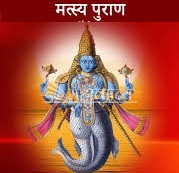
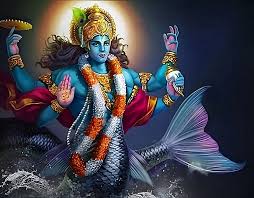
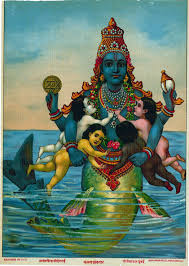
The Matsya Purana is one of the eighteen Mahapuranas of Hinduism and is considered among the oldest and best preserved texts in the Puranic tradition. Named after the Matsya avatar of Lord Vishnu—a half fish, half human form—the Purana narrates the story of the cosmic flood and the preservation of life, knowledge, and dharma. It is a foundational Vaishnava scripture, yet it also contains extensive material on Shiva, Shakti, temple architecture, rituals, yoga, pilgrimage traditions, and social ethics, making it an encyclopedic work.
Date of Composition
The Matsya Purana has a layered and complex chronology,
like all Puranas. Scholars estimate:
The text itself acknowledges the need for continuous
revision. Chapter 53 explicitly states that a Purana must be “edited and
amended to remain useful to society.”
This confirms the evolutionary nature of the Matsya Purana.
Links to download
Hindi :
Matsya Puran (HN)
English : Matasya Puran (EN)
Significance of the Matsya Purana
The Purana is especially important for:
1. The Matsya (Fish) Avatar Narrative
It recounts the famous legend of the great deluge, where:
This story symbolizes:
2. Multidisciplinary Content
Although named after a Vishnu avatar, the Purana includes:
Its breadth makes it one of the most comprehensive Puranas.
Structure of the Matsya Purana
The Purana survives in different recensions.
1. Chapter Count
2. Classification
According to Padma Purana, Matsya Purana is classified as a
Tamas Purana, though modern scholars consider such classifications symbolic and
not textually supported.
Summary of Contents
The Matsya Purana covers a vast array of topics, making it one of the most encyclopedic Puranas.
1. Flood Story & Matsya Avatar
2. Worship of Multiple Deities
The text includes:
This non‑sectarian approach reflects the plurality of Hindu worship traditions.
3. Sanskara Rituals & Festivals (Chapters 54–102)
Covers:
These chapters provide deep insight into Hindu social and domestic life.
4. Kingship & Governance (Chapters 215–227)
Offers guidelines on:
5. Architecture & Temple Design (Chapters 252–269)
One of the most valuable contributions of the Matsya Purana
is its guidance on:
Temple Architecture
Town Planning
According to art historian Michael Meister, these guidelines were recommendations, not strict rules—but archaeological evidence shows many ancient temples follow them.
6. Geography & Pilgrimage Guides (Mahatmyas)
The Purana contains several travelogues designed for
pilgrims:
Major Mahatmyas
These sections highlight sacred rivers, forests, mountains, and shrines across India.
7. Yoga & Worship Practices
Yoga teachings appear throughout the Purana.
Karma Yoga vs. Jnana Yoga
Chapter 52 states:
Eight Qualities of a Karma Yogi
Includes:
The Purana also distinguishes between:
Language
Authorship
Tradition credits Ved Vyasa as the compiler, though the
text clearly reflects contributions from many authors across different
centuries.
Conclusion
The Matsya Purana is one of the most comprehensive and
historically significant Puranas, offering:
Its encyclopedic scope and early date make it a cornerstone
of Hindu literature, shaping cultural practices, temple design, and spiritual
traditions for over 1,500 years.
Links to download
Hindi : Matsya Puran (HN)
English : Matasya Puran (EN)