




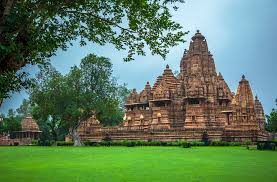
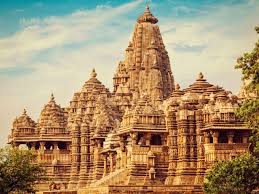
The Khajuraho Group of Monuments in Chhatarpur district, Madhya Pradesh, represents one of India’s greatest artistic achievements and a globally admired expression of ancient temple architecture. Built over 1,000 years ago, these temples are renowned for their exquisite sculptures, symbolic carvings, and stunning Nagara-style architectural brilliance. Today, they stand as a UNESCO World Heritage Site and one of India’s most visited heritage destinations. Contrary to popular belief, erotic carvings make up less than 10% of the artwork. The temples primarily depict (i) Daily life in ancient India (ii) Divine deities (iii) Mythological scenes (iv) Symbolic representations of dharma, artha, kama & moksha Khajuraho remains a living testament to India’s profound artistic, cultural, and spiritual legacy, drawing travelers, historians, dancers, scholars, and photographers from across the world.
History
of Khajuraho Temples
According
to inscriptions, the Khajuraho temples were constructed between 950 and 1050 CE
under the patronage of the Chandela dynasty, a powerful Rajput clan.
Historically, the region originally contained 85 temples spread across 20
square kilometers; today, 25 temples survive, preserved across a 6 sq km area.
Key
Historical Highlights
The
temples embody both Hindu and Jain traditions, demonstrating harmonious
coexistence between cultures of the time.
Architecture
of Khajuraho Temples
A
Masterclass in Nagara Architecture & Sacred Geometry
Khajuraho
temples exemplify the pinnacle of Nagara-style temple architecture, based on
the ancient Vastu‑Purusha‑Mandala grid system.
Key
Architectural Elements
Composition
of the Temple Cluster
Art
& Sculptures
Khajuraho
houses over 2,000 sculptures, including:
These
carvings are placed strategically to illustrate the four goals of human life:
Dharma, Artha, Kama, Moksha.
Temples
with Architectural Significance
Jain
Temples at Khajuraho
Located
in the Eastern Group, these temples highlight the artistic excellence of Jain
culture.
Religious
& Cultural Significance
Although
famed for sensual sculptures, Khajuraho temples symbolize:
The
temples reflect a highly evolved understanding of aesthetics, tantra, and
cosmic symbolism.
Khajuraho
Light & Sound Show 🎧✨
A
spectacular evening presentation illustrating the history of the Chandela
dynasty and Khajuraho’s evolution.
Timings:
Tickets:
Museums
Khajuraho
Archaeological Museum
Timings:
10 AM – 5 PM (Closed Monday)
Entry Fee: ₹20 (Indians), ₹100 (Foreigners)
Khajuraho
Dance Festival
Held
every February for a week, celebrating India’s classical dance heritage with:
Dance
performances staged against the illuminated Chitragupta & Vishwanath
temples create a breathtaking experience.
Visitor
Information
Map
How
to Reach Khajuraho
Nearby
Attractions
Western
Group
Eastern
Group
Southern
Group
Nature
& Heritage Spots
Contact