





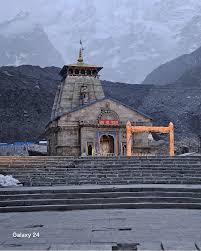
Kedarnath Temple is one of the most revered Hindu shrines dedicated to Lord Shiva, worshipped here as Kedarnath – the Lord of Kedar (the sacred field). Nestled deep in the Garhwal Himalayas of Uttarakhand, the temple stands at an elevation of approximately 3,583 meters (11,755 feet) on the banks of the Mandakini River, a tributary of the Ganga. Kedarnath is one of the twelve Jyotirlingas of Lord Shiva and a key pilgrimage site in the Chota Char Dham Yatra of Uttarakhand, along with Badrinath, Gangotri, and Yamunotri. Due to extreme winter conditions, the temple remains open only from late April or early May (Akshaya Tritiya) until Bhai Dooj / Kartik Purnima. During winter, the deity is ceremonially moved to Ukhimath, where worship continues for six months. The name Kedarnath originates from Sanskrit: • Kedara – field • Natha – lord Together, it signifies “The Lord of the Sacred Land.”
Historical
Significance
The
exact date of Kedarnath Temple’s original construction remains unknown.
However, the temple’s antiquity is deeply rooted in Hindu tradition and Puranic
literature.
Pandava
Legend
According
to legend, after the Mahabharata war, the Pandava brothers sought
Lord Shiva’s forgiveness for the sins of fratricide. Shiva avoided them by
taking the form of a bull (Nandi) and hiding in the Himalayas. When
Bhima recognized him and grasped the bull’s tail, Shiva disappeared into the
earth. His body reappeared at five locations, collectively known as the Panch
Kedar:
1. Kedarnath
– Hump
2. Tungnath
– Arms
3. Rudranath
– Face
4. Madhyamaheshwar
– Navel
5. Kalpeshwar
– Hair
The
Pandavas are believed to have established the first shrine at Kedarnath.
Scriptural
Mentions
Kedarnath
finds early references in the Skanda Purana, particularly in stories
describing the descent of the Ganga and Lord Shiva releasing sacred waters from
his matted hair at Kedara. By the 12th century, Kedarnath had already
become a prominent pilgrimage center.
Role
of Adi Shankaracharya
The
great 8th‑century philosopher Adi Shankaracharya is traditionally
credited with reviving Kedarnath Temple, along with other Himalayan
shrines including Badrinath. According to spiritual tradition, he attained Mahasamadhi
at Kedarnath. His Samadhi Mandir is located directly behind the
temple and is an important site for devotees.
Temple
Architecture and Deity
Kedarnath
Temple is a massive stone structure, built using large interlocking
slabs without mortar—an engineering marvel considering its altitude and
terrain.
Key
Architectural Features:
Daily
worship involves water abhishek, Bilva leaves, and ghee, the latter
symbolically recalling a legend associated with Bhima and Lord Shiva.
Priestly
Tradition
The head
priest (Rawal) of Kedarnath Temple traditionally belongs to the Veerashaiva
Lingayat community of Karnataka.
The
2013 Kedarnath Disaster
In June
2013, unprecedented cloudbursts and glacial lake outbursts caused massive
devastation across Uttarakhand, with Kedarnath valley among the worst affected.
Following
the disaster, the shrine was temporarily closed for restoration and safety
upgrades.
Temple
Timings & Daily Rituals
(Timings
may vary during peak yatra season and special festivals.)
Pilgrimage
& Travel Guide
How
to Reach Kedarnath
Map
By
Air
By
Rail
By
Road & Trek
Nearby
Places to Visit
Bhairavnath
Temple
Dedicated
to Bhairav Nath, the fierce guardian deity of Kedarnath. It is believed
he protects the region during winter closure.
Gaurikund
The starting
point of the Kedarnath trek, associated with Goddess Parvati’s penance and
sacred hot water springs.
Chorabari
Tal (Gandhi Sarovar)
A
glacial lake near Kedarnath where some of Mahatma Gandhi’s ashes were immersed.
Vasuki
Tal
A
serene high‑altitude lake surrounded by majestic Himalayan peaks, ideal for
experienced trekkers.
Spiritual
Importance of Kedarnath
Kedarnath
is believed to grant liberation (moksha) to devotees who worship Shiva
with true devotion. Along with Panch Kedar and Chota Char Dham, it represents
the highest aspiration of Himalayan spirituality.
Kedarnath
is not merely a destination—it is a journey through faith, endurance, and
divine grace, set against one of the most awe‑inspiring landscapes on
Earth.
Har Har Mahadev.
Contact Information – Kedarnath Temple
For
official enquiries, pilgrimage assistance, and administrative support related
to Kedarnath Temple, devotees may use the following contact details:
These contact details are provided for communication with the temple administration and the Uttarakhand Devasthanam Board regarding darshan, yatra-related information, and official services.