



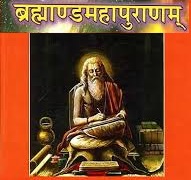
The Brahmanda Purana is one of Hinduism’s eighteen Mahapuranas, composed in Sanskrit, and is traditionally placed as the 18th Purana in classical anthologies. The title Brahmanda refers to the ancient Hindu cosmological concept of the “Cosmic Egg” (Brahmanda), from which the entire universe emerges. It is a vast and multi-layered text containing mythology, cosmology, philosophy, sacred geography, and devotional literature.
Date of Composition
The Brahmanda Purana is one of the oldest Puranas, but
its exact origin remains unclear.
Scholarly Dating
Historical Manuscript Evidence
Links to download
Hindi :
Brahamand Puran (HN)
English : Brahmanda Purana (EN)
Significance of the Brahmanda Purana
The Brahmanda Purana holds major importance in Hindu
tradition due to the following features:
1. Contains the Lalita Sahasranama
One of the most sacred hymns dedicated to Goddess Lalita
Tripurasundari appears in this Purana.
It is a vital text for Shakta worship and widely chanted across India and
Southeast Asia.
2. Includes the Adhyatma Ramayana
The Adhyatma Ramayana—a philosophical and Advaita
Vedanta-based retelling of the Ramayana—forms approximately one‑third of the
Purana.
This section is attributed to Ramananda, founder of the Ramanandi Sampradaya.
3. Non-Sectarian Nature
The Purana reveres:
It blends Vedanta, Samkhya, Yoga, Bhakti, and Tantric
ideas, making it one of the most inclusive Puranas.
4. Influence in Southeast Asia
The discovery of the Javanese-Brahmanda shows the text’s
early spread to Indonesia, influencing Balinese Hinduism.
Structure of the Brahmanda Purana
The commonly available version of the Purana is divided
into three Bhagas (parts):
1. First Bhaga
2. Second Bhaga
3. Third Bhaga
Total Chapters: 156
Number of Verses
These variations demonstrate the Purana’s evolving
manuscript tradition.
Summary of Contents
The Brahmanda Purana is a rich and diverse text, containing:
1. Cosmology & Time Cycles
Detailed descriptions of:
2. Sacred Geography
The Purana provides elaborate descriptions of:
3. Lalitopakhyana (Narrative of Goddess Lalita)
Approximately 20% of the Purana.
Themes include:
Narrated as a dialogue between Hayagriva and Sage Agastya.
4. Adhyatma Ramayana
Approximately 35% of the Purana.
This section alone is often treated as a standalone sacred text.
5. Mahatmyas (Pilgrimage Guides)
Around 47 chapters describe sacred regions such as:
These chapters serve as ancient travel guides, highlighting temples, rivers, rituals, and local mythology.
6. Other Notable Texts Inside the Purana
Language
Authorship
Traditionally attributed to Vyasa, the legendary compiler
of all Puranas.
In reality, the Brahmanda Purana is a multi-author, multi-century text composed
between the 4th century BCE and 10th century CE, with later additions.
Conclusion
The Brahmanda Purana is one of the most philosophically
rich and spiritually influential Puranas. Its blend of:
makes it a cornerstone of Hindu scriptural heritage.
With the inclusion of Lalita Sahasranama and Adhyatma Ramayana, this Purana
holds a special place in both Shakta and Vaishnava traditions.
Links to download
Hindi : Brahamand Puran (HN)
English : Brahmanda Purana (EN)