



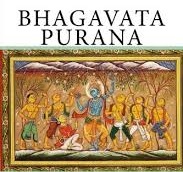
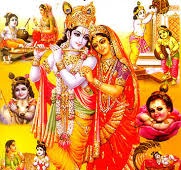
The Bhagavata Purana, also known as Srimad Bhagavatam, is one of the most revered scriptures in Vaishnavism, the Hindu tradition devoted to Lord Vishnu. This Purana places an exceptional emphasis on bhakti (devotional worship) as the path to spiritual realization, liberation (moksha), and inner bliss. It presents a distinct interpretation of dharma centered on loving devotion rather than ritualistic or philosophical approaches alone.
Origin and Date of Composition
Most scholars place the composition of the Bhagavata
Purana between the 9th and 11th centuries CE, although some propose an
earlier origin around the 6th century CE.
Its devotional tone resembles the works of the Tamil Alvar saints, whose
emotional outpourings of devotion shaped early Bhakti literature in South
India.
Over the centuries, multiple manuscripts developed in
different regions of India. This resulted in several variations and
recensions, many of which continued to evolve until the 18th century.
The Bhagavata Purana is often honored as the “Fifth
Veda” because of its spiritual authority, poetic brilliance, and immense
influence on Hindu devotion and culture.
Key reasons for its importance:
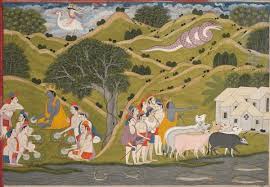
The Purana is especially treasured for Book,
which narrates Krishna’s childhood in Vrindavan. These narratives are
central to many Krishna traditions across India.
Scholars and saints across centuries—such as Charlotte
Vaudeville, Gaudiya Vaishnava teachers, and the Ekasarana Dharma tradition
of Assam, have described the Bhagavata Purana as one of the purest
expressions of Vedantic wisdom and divine devotion.
Role in Various Traditions
The Bhagavata Purana is a foundational scripture for:
Many Krishna‑centred traditions rely heavily on the
Bhagavata Purana to express the idea that Krishna is the complete and
original form of divinity, while other incarnations are partial
manifestations.
Structure of the Bhagavata Purana
The text is divided into:
Although each section has its own theological depth, Skandha
X and XI are the most well‑known for their devotional and philosophical
richness.
Contents: A Brief Summary
The Bhagavata Purana is framed as a spiritual dialogue
narrated in stages:
1. Ugrasrava
Suta
retells the scripture to the sages assembled at Naimisha forest.
2. The
scripture recounts how Veda Vyasa, creator of the Vedas and Mahabharata,
still felt incomplete.
3. Sage
Narada instructs Vyasa to compose a text focused purely on devotion (bhakti)
to God.
4. Vyasa
then imparts this wisdom to his enlightened son Shuka.
5. Shuka
narrates the Bhagavata Purana to King Parikshit, who has only seven days
left to live.
Parikshit’s final week becomes the backdrop for the
recitation. As he listens to the stories of Krishna and the nature of divinity,
he attains spiritual liberation.
Writer and Language
Conclusion